
Choosing between resin and filament 3D printing depends on what you want to make, your budget, the required surface detail, the mechanical properties of the finished part, and the time available for post-processing. Filament is generally more practical for beginners, functional parts and larger projects. Resin is especially useful for intricate miniatures and smooth, highly detailed models. But resin is not always more expensive per finished part: shared costs can make batches economical.
In this guideJump to a section
Quick verdict
| Requirement | Suggested starting point |
|---|---|
| Beginner-friendly printing | Filament |
| Large household projects | Usually filament |
| Fine details and small miniatures | Resin |
| Functional mechanical parts | Often filament; check material properties |
| Smooth surface finish | Usually resin |
| Detailed miniature batches | Often resin |
| Minimal post-processing | Usually filament |
| Lowest cost per finished part | Depends on project and batch size |
Choose the technology based on the finished part's requirements, not just the printer purchase price.
What is filament 3D printing?
Filament 3D printing, also called Fused Deposition Modeling (FDM) or Fused Filament Fabrication (FFF), melts thermoplastic filament and deposits it through a heated nozzle, building an object layer by layer. Common materials include PLA for general prototypes and decorative objects; PETG for many practical parts; ABS for applications requiring increased heat resistance; TPU for flexible parts; and engineering-grade nylon for demanding applications. These are broad tendencies, not guarantees for every formulation.
Filament printing offers a wide selection of materials, adjustable infill and wall thickness, and usually a simpler finishing workflow. Limitations include visible layer lines, small-feature reproduction, orientation-dependent strength, support waste and multicolor purge. Some materials require controlled temperatures and an enclosure.
What is resin 3D printing?
Resin printing uses light to solidify liquid photopolymer. SLA uses a scanning laser, DLP uses a projector and MSLA uses an LCD mask to expose printable regions of a layer. Many desktop machines are MSLA systems. They can reproduce intricate surfaces, fine lettering, detailed faces and delicate geometry. Specialized resin formulations are also available for engineering uses.
Resin requires careful handling, washing and post-curing as specified by the manufacturer, plus cleaning and replacement consumables. Some standard decorative resins are relatively brittle. Batch efficiency varies by machine, geometry and settings.
Side-by-side comparison
| Feature | Filament (FDM) | Resin (SLA/DLP/MSLA) |
|---|---|---|
| Raw material | Thermoplastic filament | Liquid photopolymer |
| Process | Heated extrusion | Light-based curing |
| Fine details | Good to very good | Usually excellent |
| Surface | Layer lines possible | Usually smoother |
| Mechanical parts | Wide material selection | Formulation-dependent |
| Larger objects | Often practical | Build volume dependent |
| Finishing | Usually simpler | Washing and curing |
| Waste | Supports, purge, failures | Supports, residue, failures |
| Maintenance | Nozzles, beds, moving parts | Vat films, tanks, light systems |
| Batch production | Depends on extrusion path | Often attractive on MSLA |
| Safety | Ventilation, thermal precautions | Ventilation, chemical precautions |
Is resin printing more expensive than filament?
Raw material price alone cannot answer this question. A finished print can include material, electricity, printer wear, maintenance, labor, failures and packaging. Resin can additionally involve washing solution, protective equipment, vat film replacement and curing energy.
| Material | Illustrative purchase price | Consumption | Cost |
|---|---|---|---|
| PLA | $20/kg | 100 g | $2.00 |
| PETG | $25/kg | 100 g | $2.50 |
| ABS | $23/kg | 100 g | $2.30 |
| TPU | $35/kg | 100 g | $3.50 |
| Standard resin | $30/L | 100 mL | $3.00 |
| Specialty resin | $60/L | 100 mL | $6.00 |
These are assumed prices, not market averages. Grams measure mass and milliliters measure volume, so the rows do not represent identical finished models. Slice the same geometry using appropriate settings for each technology to compare material use fairly. Include supports and purge once, not twice.
Filament cost = (grams ÷ 1,000) × price per kilogram. For 150 g at $20/kg, material cost is $3.00.
Resin cost = (mL ÷ 1,000) × price per liter. For 80 mL at $30/L, material cost is $2.40. If resin is sold by mass, use its manufacturer-provided density for conversion.
Try our Filament Cost Calculator and Resin Cost Calculator.
Electricity cost
Power varies with machine design, temperature, settings and ambient conditions. FDM printers power their hot end, build plate, motors and fans; resin printers power their light source, electronics and movements. Washing and curing equipment should be counted separately.
Electricity cost = average watts ÷ 1,000 × print hours × local price per kWh. At an illustrative $0.18/kWh, a 150 W FDM printer running five hours uses 0.75 kWh and costs $0.135 (about $0.14). An 80 W resin printer running five hours uses 0.40 kWh and costs $0.072 (about $0.07), before finishing energy. These are assumed power levels, not measured printer specifications. Use a suitable energy meter and your utility bill, or consult U.S. EIA electricity data. Estimate your electricity cost.
Complete printing cost: worked example
Suppose both technologies can produce an acceptable small decorative model. The following figures are illustrative, not physical tests. No sales fees, taxes, packaging or failures are assumed here.
Filament assumptions
| Expense | Calculation | Cost |
|---|---|---|
| Material | 30 g at $20/kg | $0.60 |
| Electricity | 150 W × 2 h × $0.18/kWh | $0.054 |
| Printer wear | 2 h × $0.10/h | $0.20 |
| Labor | 3 min at $24/h | $1.20 |
| Total | $2.054 |
Estimated cost: $2.05 per piece.
Resin assumptions
| Expense | Calculation | Cost |
|---|---|---|
| Material | 20 mL at $30/L | $0.60 |
| Electricity | 80 W × 3 h × $0.18/kWh | $0.0432 |
| Printer wear | 3 h × $0.10/h | $0.30 |
| Film wear | Per plate | $0.10 |
| Shared handling | 4 min at $24/h | $1.60 |
| Per-piece finishing | 1 min at $24/h | $0.40 |
| Wash and PPE | Per piece | $0.20 |
| Total | $3.2432 |
Estimated cost: $3.24 per piece. For a single piece under these assumptions, filament is cheaper by about $1.19.
When does resin become cheaper?
A compatible MSLA machine can expose multiple areas of the same layer together. Similar-height objects that fit on one plate may not increase print time proportionally. Some expenses can therefore be shared. Actual time still depends on exposure, geometry, lift movements and machine settings.
For this example, variable resin expenses per piece are $0.60 material + $0.40 finishing + $0.20 wash/PPE = $1.20. Shared expenses per plate are $0.0432 electricity + $0.30 wear + $0.10 film + $1.60 handling = $2.0432.
Resin cost per finished piece = variable cost + shared plate cost ÷ saleable pieces.
| Pieces on one plate | FDM cost/piece | Resin cost/piece | Cheaper |
|---|---|---|---|
| 1 | $2.05 | $3.24 | Filament |
| 2 | $2.05 | $2.22 | Filament |
| 3 | $2.05 | $1.88 | Resin |
| 6 | $2.05 | $1.54 | Resin |
| 10 | $2.05 | $1.40 | Resin |
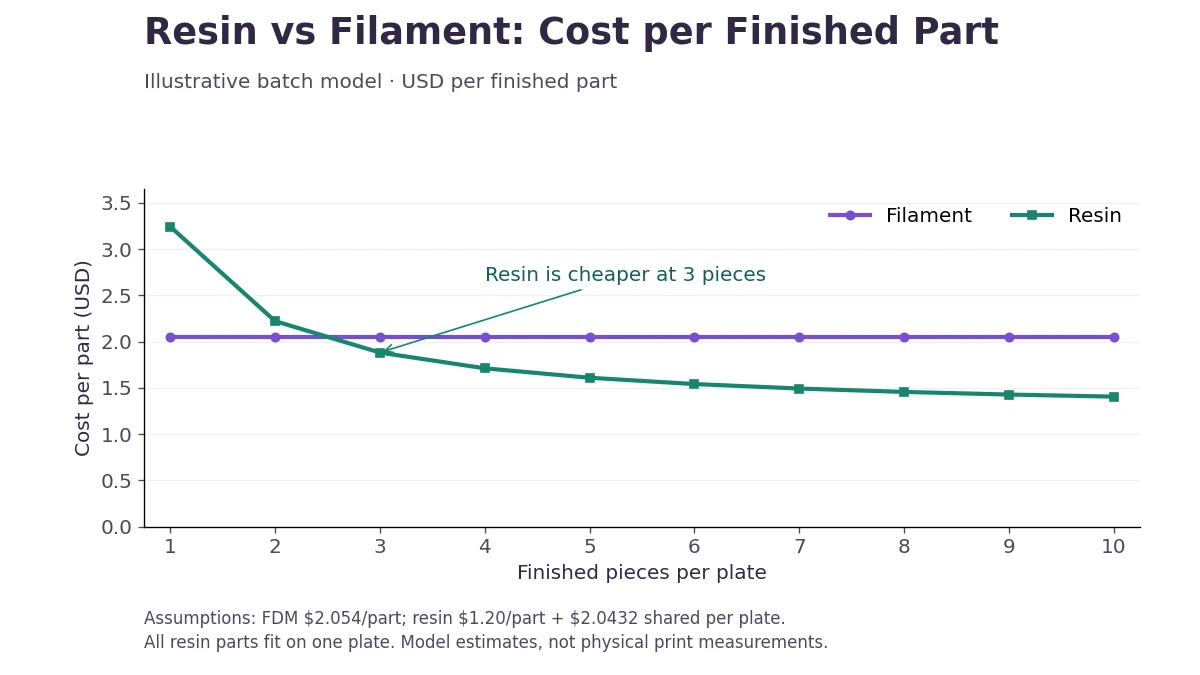
Illustrative model. Shared resin costs stay constant, FDM cost is constant per piece, and all parts fit on one plate. Not a physical printer test.
At six pieces, FDM costs $12.324 and resin costs $9.2432 before rounding, saving $3.0808 (about 25%). The break-even quantity is shared resin cost ÷ (FDM cost per piece − resin variable cost), provided the denominator is positive. Here $2.0432 ÷ ($2.054 − $1.20) ≈ 2.39; three whole pieces make resin cheaper. If the threshold is exactly an integer, that quantity gives a tie, and a larger batch is needed for a strict saving. If resin variable cost is already equal to or greater than FDM cost and shared costs are nonnegative, resin cannot be strictly cheaper in this model. Additional print runs must be counted when plate capacity is exceeded.
Compare your own batch costs
Enter your actual per-piece and shared costs in the interactive calculator. Choose Load Example only if you want the illustrative figures. This simplified model does not assume extra costs or predict printer capacity.
For a full job budget including failures, use the Resin vs Filament Cost Comparison Calculator.
The hidden cost of failed 3D prints
If every failed attempt consumes the full repeatable cost, and success probability remains constant, expected repeatable cost per successful print equals cost per attempt ÷ (1 − failure rate).
| Failure rate | $10 repeatable cost per successful print |
|---|---|
| 0% | $10.00 |
| 5% | $10.53 |
| 10% | $11.11 |
| 20% | $12.50 |
| 30% | $14.29 |
| 50% | $20.00 |
At 20% failure, simply adding 20% gives $12, whereas repeated failures give an expected cost of $12.50 under the stated assumptions. Early failures may use less material and an individual failed piece may not require a full plate reprint. Apply this model only to repeatable expenses, not successful-part finishing or packaging. Our main calculator implements a full-plate failure allowance; see methodology.
Print quality and accuracy
Resin usually reproduces fine textures and small facial details with smoother surfaces, which is useful for miniature models, jewelry patterns and visual prototypes. Fine FDM nozzles and optimized layer heights can also give excellent results. Layer height is not a guarantee of dimensional accuracy: calibration, shrinkage, exposure, orientation and material behavior matter. For a large organizer or bracket, additional surface detail may not offer useful performance. Compare prints at the quality required for your application, not at arbitrarily matched settings.
Strength and durability
No universal strength winner exists. PLA is stiff and easy to print but has relatively limited heat resistance. PETG may offer useful toughness; ABS can offer greater heat resistance; engineering nylon can provide wear resistance. Standard resin can be brittle, but tough and flexible resins are available. Tensile strength, impact resistance, stiffness, flexibility and heat resistance are different characteristics. FDM strength may vary with layer orientation, and resin behavior depends on chemistry, cure, geometry and settings. Compare technical datasheets for the specific formulations and verify that the finished part is suitable for its load.
Which technology is faster?
FDM print time depends on nozzle size, extrusion path, walls, infill, supports and travel. More objects usually mean more deposited material and longer paths. MSLA timing depends largely on layers, exposure and movement between layers. Similar-height batches may be efficient, but laser-based SLA behaves differently. Compare the entire time to a usable finished piece, including cooling, support removal, washing, drying, curing, sanding or assembly. A short printer cycle alone is not a reliable measure of throughput.
Safety and workspace requirements
Neither method is hazard-free. NIOSH identifies potential airborne particle and chemical exposures from 3D printing. Provide appropriate ventilation, follow machine instructions and avoid contact with hot components. For uncured resin, follow its Safety Data Sheet, use appropriate chemical-resistant gloves and eye protection, and avoid skin contact. Do not pour unused resin, contaminated wash water or solvents down drains. Follow manufacturer disposal guidance and local hazardous-waste rules. If you cannot provide a suitable resin handling workspace, filament is often the more practical starting point. See CDC/NIOSH safe 3D printing guidance.
Which printer is best for your project?
| Project | Suggested starting point | Why |
|---|---|---|
| Small tabletop miniatures | Resin | Fine detail |
| Household organizers | Filament | Practical size and price |
| Mechanical prototypes | Filament or engineering resin | Required properties |
| Jewelry casting patterns | Suitable castable resin | Fine geometry |
| Cosplay armor | Filament | Larger parts |
| Decorative models | Either | Size and detail |
| Flexible covers | TPU or suitable flexible resin | Flexibility |
| Large enclosures | Filament | Build volume |
Verify the specific material for the application. General-purpose printed materials should not automatically be considered suitable for food contact, medical or safety-critical uses.
How to reduce printing costs
For filament, optimize walls and infill for actual requirements, reduce unnecessary supports, and account for multicolor purging. For resin, organize compatible parts on the plate, track film and tank replacement, and record material and cleaning consumption. For both technologies, maintain equipment, record failures, use reliable slicer estimates and track hands-on labor. Avoid compromising quality or safety to reduce costs: a cheaper failed print is not a saving.
Frequently asked questions
Is resin 3D printing better than filament?
Resin often produces finer detail; filament is generally practical for larger and functional objects. The best method depends on the project.
Is filament printing cheaper than resin?
Often for individual general-purpose prints. Suitable resin batches can cost less per finished piece.
Is resin stronger than PLA?
Not necessarily. Compare the specific resin and PLA datasheets, the loading direction and the required mechanical property.
Which printer is better for beginners?
Filament typically requires fewer chemical-handling and finishing steps.
Which is better for miniatures?
Resin is usually preferred for small detailed figures. Filament can be useful for larger figures and terrain.
Does resin printing use less electricity?
It depends on the machine, operating power, duration and washing or curing equipment.
Can I make money with either technology?
Yes, if demand and selling prices cover materials, electricity, labor, fees and other expenses. Use our Profit Calculator to evaluate your own assumptions.
Can resin print multiple objects without doubling time?
Many MSLA printers can do this for compatible objects of similar height, within plate capacity, but it is not guaranteed for all settings and machines.
How do I compare costs accurately?
Slice equivalent models with appropriate settings, record material, time, actual energy, labor, wear, consumables and expected failures, then compare cost per usable finished part.
Final verdict
Filament is generally a versatile starting point for everyday objects. Resin is especially attractive when small features and smooth surfaces matter. For a printing business, choose the method that produces a saleable part meeting the customer's requirements at the lowest sustainable cost. Raw material price alone is insufficient. Compare your costs now.
Sources and assumptions
- UltiMaker: Resin vs FDM printing
- Formlabs: SLA, DLP and MSLA comparison
- U.S. Energy Information Administration: electricity price data
- CDC/NIOSH: Approaches to Safe 3D Printing
- Our calculation methodology
All numerical examples are illustrative models with stated assumptions, not measured printer tests or verified market-average prices. The featured image is an original illustrative graphic, not a photograph of a physical experiment.
Estimate your own print costs
Use your actual material, energy and labor costs.
Open free calculator ↗